
Alex Hunt:
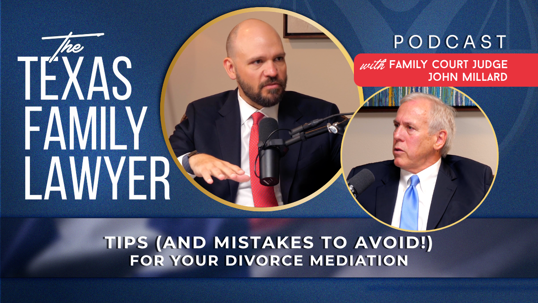
Welcome back to the Texas Family Lawyer Podcast. My name is Alex Hunt, managing attorney at Hunt Law Firm. And today, if you're facing divorce in Texas, you're most likely going to end up in mediation. And today, I'm very excited to be joined by former judge John Millard. He was the associate judge in the 328th Judicial District court in Fort Bend County. He's seen it all in the courtroom, and now he has started a mediation practice based in Fort Bend County, but serving the entire Greater Houston area. And we're going to get the benefit of his expertise and what he's seen, good lawyering that he's seen, not so great lawyering, what you want to see, what you don't want to see. Judge Millard, thanks so much for joining me.
John Millard:
Well, thank you so much for having me. I'm honored to be here today.
Alex Hunt:
So, tell me a little bit about you. Give me your origin story. Tell me a bit about your background.
John Millard:
Well, sure. So, I've been a lawyer a long time. Sometimes, I'm surprised when I count the number of years that I've been doing this. I've always been a trial lawyer, so I've always been in the courtroom, and I spent several decades handling family law cases, and I've literally handled every type of case you can possibly handle. I've had numerous bench trials as a lawyer, quite a few jury trials as a family law lawyer. And so, after doing that for many years, I got an opportunity by Judge Walter Armatys to serve as his associate judge, which kind of caught me off guard and out of the blue when he made the offer to me. And after thinking about it and talking to my wife about it, I decided that would be a good fit for me. And so, I became his associate judge and served in that capacity for four years.
And then, after leaving the bench, I decided that pursuing the mediation and arbitration practice would be a good fit. And so, that's what I've done. And I've been very pleased with it. I enjoy doing it. It's actually... My background and my experience, I think, has given me a good view to help people settle cases because on the one hand, I've represented people, and I've been an advocate. And so, I have that view. And then, I had time on the bench, and I've seen the view from the bench and what judges see and what's important to them and what annoys them, that kind of thing. And now I'm acting as a mediator, and I think that that experience has really helped me assist people in getting their family law cases resolved.
Alex Hunt:
Well, you and Judge Armatys, Walter Armatys, you formed mediation judges with Armatys Millard. Tell us a little bit about where folks can find you and what y'all do.
John Millard:
Sure. Well, the easiest way to find this is via our website, mediationjudges.com. And once you're there, you can get a little bit of background about Judge Armatys and I, what our history is and what our experience is. And then importantly, you can see our booking calendar if you want to book a mediation session, and you can view it in real time. And with a few simple clicks, if you find a date that works for everyone, you're booked, and you get an immediate confirmation of your session, and then we follow up with more detailed information, reminder emails, that kind of thing.
Alex Hunt:
Wonderful. We've mediated quite a few cases together successfully and I always appreciate that. And there's a difference between mediating with a former judge who has seen how judges will react to different situations, and you can provide a unique perspective for our clients, especially when you know the current judges so well and you can say, "Look, I see the fact pattern. I feel for you. This is just not going to fly if you go to court with this set of facts."
John Millard:
Yeah. I mean, I think that is... Actually, one of our better value propositions is that we have that experience. And I tell people this all the time, Alex. I don't have a crystal ball. I can't predict for you everything that's going to happen in court, but sometimes you get a pretty good idea of which way things are going to go. And I feel that that helps people make decisions about their cases and hopefully avoid making a mistake by going to court when they should settle.
Alex Hunt:
Absolutely. Well, let's jump right in because if you are going through a divorce, especially if you're in Texas, more than likely you're going to find yourself in a mediation, and it comes in many different forms. Sometimes, it's in person. Sometimes it's on Zoom. But for a new litigant that's just starting their divorce journey, talk a little bit about what mediation is.
John Millard:
Yes. Well, at its core, mediation is a voluntary, confidential settlement process where parties get together with someone who's trained to help them resolve disputes, someone who's neutral. And it's an opportunity for you to sit down and explore whether you can reach agreements that help you avoid going to court. And in Texas, I think it's very important that people understand that while we say mediation is a voluntary process, and it is in the sense that no one can make you settle or make you do anything you don't want to do, it's very much an involuntary process in terms of whether the court requires you to participate in it.
And I think people are sometimes surprised to find out that they may have to mediate the case twice because most courts, I think this is pretty universal across the state actually, they require that you attend mediation before you get a temporary orders hearing. And then, even if you have attended mediation, if you have a trial that's necessary after that, they make you do it again. And there's a good reason for that. And the main reason is that we are very often successful in settling cases, and judges know that.
They know that if the parties will take the time to sit down with someone who can help them settle the case, there's a good chance they can reach an agreement, and then the court doesn't have to handle that case. And courts are very busy. They've got plenty to do. And if they can get cases resolved by agreement, that's a good thing for everybody.
Alex Hunt:
Even when the parties think, "There's absolutely no way that this case is ever going to settle," I mean, how many times have you gone into a mediation room in the first 10 minutes and one of the parties is like, "Good luck. We'll be out of here in 15 minutes because this isn't going to happen."
John Millard:
That happens a lot, actually. And I kind of chuckle a little bit when I hear that because sometimes, and lawyers, trial lawyers in particular, they can be a little brash sometimes, and they are saber rattling. And so, they'll come in and say things like, "Let's just declare an impasse. We want to check the box and just get this done." I say, "Okay, well hold on a minute. Let's talk a little bit about it and see what we can do." And I've actually had a lot of success in settling those types of cases. And if you take the time to sit down and focus and see if there's some middle ground that can be reached, very often you can walk away with an agreement.
Alex Hunt:
How do you approach those cases that are the impossible, "He's never going to settle. She's come to this in bad faith"? What's your approach to providing solutions for those folks?
John Millard:
Well, it's always important that the parties understand that sometimes what you think about your case is not the reality of what will likely happen when you go to court. And very often, you have people, especially in divorce cases where there are a lot of hurt feelings and there's a lot of history that's led up to them going through a divorce and they have a lot of unresolved grievances that they feel that they need to address. And so, you really have to kind of move beyond that and move into, "Look, we can't do anything about your marriage. We can't fix your marriage. That's not what we're about. We're here to talk about moving forward and what we can do to get you through this and move on with your life."
Alex Hunt:
Clients that I've had especially, they do have those grievances and they're legitimate grievances, and they feel like I need to have my day in court. And mediation can sometimes provide that platform for somebody to... It's not court. You are not wearing your judge hat in mediation, but they can have their day in court and have a neutral third party listen to their grievances and sympathize and empathize. And oftentimes, especially if the facts are not necessarily on our side, I would much rather have my clients have their "day in court" in mediation versus in a week-long trial where they're going to run up all types of bills, and they're going to have all their dirty laundry out there for the public to watch. Out of the box solutions? How do you come up with interesting solutions for folks when there's difficult situations that arise?
John Millard:
Well, I think what you said is actually very true and very important. People do need a chance to have their day in court. And so, I always try to make sure that they're heard on that, and I give them an opportunity to talk about that. And then, I pivot into, "Okay. Well, I understand that. Let's talk a little bit about what your goals are to get you out of this. What can we do to get you through this and get agreements in place that make sense for you, make sense for your financial future that are in the best interest of your children?" I try to pivot away from all of the hurt and hard feelings and look forward into, "What can we do to come up with solutions to get you past all of that?"
Alex Hunt:
So, for a new litigant, they're new to mediation, one impression that I've gotten from my clients, and they usually say, "Whew," when they think that mediation is them sitting across the table from their spouse or their ex-spouse, and then when I can break the news to them that, "No, no. You're not even going to see them. They're going to be in another room or another breakout room if you're on Zoom." Can you walk viewers through the process of turning on the Zoom camera or coming into your office? What does it look like? Walk them through what a mediation looks like.
John Millard:
Yes. And that's actually a very important point because there are certain other types of cases where the format and the custom is very different than family law. So, as an example, if you have a contract case, it's very common to get everybody together, and each side makes an opening statement, and then there's some dialogue back and forth, usually facilitated by the mediator. Then, you break into separate rooms and start negotiating. We have found in family law that that is generally very counterproductive. And so, we don't go there. It's very rare that you do that. And I think most of the time, the parties are actually relieved that they don't have to stare each other down.
And one other thing I'd say, that we have a rule that we don't allow non-parties to attend the mediation. And there are some exceptions to that, of course, if somebody has someone they need there, they have some incapacity or something and they need a parent there or something like that. But we generally don't think it's productive to have girlfriends and boyfriends show up. It almost always is a disaster, but we get everybody there and most of the mediations that we do these days are via Zoom.
And I think that everybody has adapted to that and feel very comfortable doing Zoom. And it has a lot of benefits over meeting in person. You don't have travel. You don't have traffic and all of the things that you have to do to go in person. So, we put people into separate rooms called breakout rooms. And then customarily, I start with the petitioner who filed the case and get information about their goals and what they would like to see happen. And then, I go into the room with the respondent and have a similar discussion and learn their side of the case and what their goals are. And then, ultimately I present the proposal that I got from the petitioner, and we go over that, and we talk about that and come up with things that we can agree to, things that we can't agree to, and then generally get a counter offer that I take over and present to the other side.
And that process goes back and forth until ultimately, hopefully, you reach an agreement. One of the real benefits of Zoom is the ability to screen share during the mediation. I find that to be very helpful because we can do things like share a spreadsheet where we have an inventory of the property and the debts and the values and how those assets and debts will be allocated between the parties.
It's very helpful to have that as a visual and in real time go through it and kind of move things around and see what ifs. And then, at the end of the case, when you get the case resolved and you're moving on to the actual mediated settlement agreement, I find it very helpful to screen share and go over it and make sure that everybody's in agreement with it before we circulate it for electronic signature.
Alex Hunt:
Definitely.
John Millard:
Because if you don't do that, what happens is you circulate it and then you get somebody saying, "Hey, wait a minute, we forgot this," or, "We didn't agree to that."
Alex Hunt:
One side will say, "I'm ready to go. Let's sign it." And the other side will say, "Not so fast."
John Millard:
That's right.
Alex Hunt:
And when I was trained as a mediator many years ago, and I certainly don't do as many mediations as mediator as you do, I'm more often in the advocate chair, but I had somebody explain it to me as shuttle diplomacy in family law mediations, kind of like Henry Kissinger and you're going back and forth. And often what a lot of my clients are surprised at is you might be, especially early on in the mediation, in one room for an hour or an hour and a half. And that just means that you're doing what you need to do in order to get somebody in a place where they would be able to reach a settlement. And then as the mediation goes on, you're shuttling back and forth more often. Sometimes, it's even a few minutes. "Okay." when you're in the last few points, "You said that you needed this. Let me go in the other room." And then two minutes later, you're coming back and kind of finishing up.
John Millard:
Absolutely. I actually warn people at the beginning, "I'm going to go talk to the petitioner. Now, please be patient with me. This process takes time." So, I may be gone quite a while, and I prepare them for that. And then, I usually suggest to them that, "Make good use of the downtime. While I'm over there talking, be working with your lawyer and going through some of these things and making sure that you're on the same page. And then when I come back, we'll have a chance to talk. I'll give you equal time."
Alex Hunt:
Yeah. No, most certainly. So, as a mediator, what are some of the biggest mistakes that you've seen litigants and lawyers make in mediation?
John Millard:
Boy, there are a lot of them, unfortunately. And the biggest one is coming to mediation unprepared. And that, unfortunately, happens a lot. And I get that lawyers are very busy as a profession. You always have more to do than you seem to have time for, but it is so critical to come prepared. And that involves having discussions with your client before the mediation date and sitting down with them and going over what the game plan is and what their expectations are and perhaps setting realistic boundaries on their expectations and alerting them to things in advance that are not good to bring up for the first time at mediation.
And you know when your client has some baggage or some issues that are going to definitely impact the case. You need to have that discussion with your client well in advance of mediation, so they don't feel blindsided by it when you're in mediation. So, not being prepared is a very big one. And as part of your expectation setting with the client, I think it's important that they understand that you can sometimes confuse what they think ought to be fair with what actually realistically can happen in court. And there are common misconceptions in family law, and you see them. People say things like, "Well, I paid for everything, and so I ought to get everything." And they don't understand the concept of community property and so forth.
So, I think it's important for the lawyers to have those kinds of discussions before they get there. And then another thing, and this kind of drives me nuts, Alex, is very often the lawyers will come in and the first thing they say is, "Well, we need this bank statement. We need this record. We don't have this. We don't have that." And so, the first hour or two of your session is essentially doing discovery that should have been done well in advance of the mediation. You should have already exchanged all the information. Sometimes, there's little pieces that you don't have, and that's understandable, but I've seen cases where literally there was almost no exchange and now they come into mediation, and so they want me to facilitate discovery. And that's a very poor use of the time.
Alex Hunt:
Because you've got your lawyer. Your spouse has their lawyer that they're paying. And you're paying the mediator. And oftentimes, especially we'll get to the end of a mediation and we'll be fighting about the pots and the pans. And I'll say, "You're spending $1,000 an hour to fight over the pots and the pans."
John Millard:
Oh. Absolutely.
Alex Hunt:
"Go get another pot or pan." And so, being able to keep your client big picture like that is really important. I completely agree with you that preparation is so important. I kind of separate that into two different levels of preparation. So, what you mentioned was doing all of the pre-work, in terms of written discovery and whatnot, to allow your attorney and you to have the tools to know, "These are all the assets. These are all the debts. These are the problem spots in our case. These are the problem spots on their case." But you need to know all of that before you can appropriately evaluate the case.
The second level of preparation is actually preparing the mediator and your client for the actual mediation. And so that's where we do, and hopefully you find this helpful as a mediator. We do a summary of relief requested where we go over with our client what they're seeking to get out of this process.
It kind of serves as our first offer, and we lay that out in great detail, and then we'll provide it to you usually in a Word document. So that way, as we're going through the mediation, you can kind of use that as your template. The other side will say, "Well, no. Not $100,000 out of the retirement, but $80,000." And you can go in and plug that in, but you're using our template for what potentially the ultimate settlement is going to be. And then, having those conversations with your client ahead of time, because when you get into mediation, even though you're not facing down the other party face-to-face, it can get very emotional. Even clients that will think, "I'm fine. We've been doing this for a while." It can get very emotional. And so, I always have conversations with my client, not just about what our first offer is, but pre-conversations about, "What are the guardrails for what you would be willing to accept?"
And if we go beyond that guardrail, I'm going to tell you, "We're past what you said you would accept. This we're going to court line." Because if you're in mediation and you're very emotional and you're in your feelings and you surpass that line, you might regret that later on that you did that. So, it's better to have those guardrails in place before you get to that place, and then you and your lawyer are on the same page and you can hold each other accountable.
John Millard:
Yes. And you mentioned something I think is very, very important. And I've had a lot of experience mediating with your firm, and your firm does it right. They always send material in advance. I will get a confidential mediation memorandum, a requested relief memo. And Alex, I'm actually shocked sometimes that I show up for a case and I get absolutely nothing from one of the lawyers, and I've never understood that.
I've never understood that because you're putting yourself at a huge disadvantage. When you give the mediator your confidential memorandum and your requested relief, you're giving the mediator a roadmap of where you want to end up. And I read everything. If the lawyers send it to me, I read it all. And very often, almost always, I'll go look at the court's file before we begin the session because I want as much information about the case as I can get, because that helps me. That helps me understand the case better and help the parties reach agreements. But I think in terms of mistakes, that is a huge one that lawyers make. They don't go to the task of mapping out what they want. And I think they hurt themselves. Not only do they not give me a roadmap, they don't give themselves a roadmap. They come in and they have not a clear picture of where they want to end up. And I've never really understood that.
Alex Hunt:
And the mediation process by its very nature is going to be pretty fast-paced. You're in a four to sometimes eight hour. As you know, my firm recently had a case where it was probably about a 12, 14 hour mediation.
John Millard:
It was a long one.
Alex Hunt:
We were locking up the office at around 10:30, but we got it done. I appreciate that. And you do your client a disservice as the attorney if you are doing discovery on the fly and you're learning about the case on the fly and you're teaching the mediator about it in the room because all of that work can be done ahead of time, and then those minutes that are reserved for negotiation can't be used for that purpose.
John Millard:
Right.
Alex Hunt:
So, what are some other things that you've seen litigants or lawyers do that they've gotten really great outcomes for their clients and it's really kind of set them apart? What did they do to be successful?
John Millard:
Well, it's pretty simple really. The best outcomes occur when the lawyer is prepared, when they've had conversations with their clients about what is realistic and what is unrealistic in advance. And they show up knowing what the estate consists of. They know all the assets. They know all the debts. They know things about the children, their needs. They know about their schedules. They know about what schools the parents would like them to attend. They know information about those schools, where they rank and the school rankings and things like that. And they've had those discussions with their clients before mediation. And so, they've learned a lot about their client's needs and the children's needs, and they show up prepared, and that makes a very big difference in the outcome. And having a realistic idea of what could happen if you had to go to court is very helpful, as well.
And so, I think to the extent that you have that discussion with your client in advance, it goes a long way into getting the case settled successfully. And you can, to a very large degree, when you know you have issues, you can, in advance, start exploring creative solutions to that issue. And I think the really good lawyers in mediation don't just paint by the numbers, and, "This is conservatorship, check, possession and access, check." They go through, and they give some real thought into alternative solutions that may fit everybody's needs and work and be kind of a win-win situation. Those are the really good lawyers in my opinion.
Alex Hunt:
And some folks that have watched this channel might think this is a family lawyer podcast. Why do we find ourselves talking about mediation probably just as much as we do hearings and trials? And for us, and I don't know what it's like in your experience, or if you just have any more information kind of globally, probably about 80% of our cases resolve themselves in mediation. And so yes, we're doing all that prep work because we might ultimately go to trial, and it's better to be prepared and ready to go, and we always are, but at least in our case, it's usually about four out of five, maybe even more of these cases resolved in mediation. And so, you don't just go to mediation and see what you can get done. There's real strategy that goes into it. What does it look like in your mediation practice?
John Millard:
Well, I agree with you. I think that a fairly high percentage of cases do resolve, and I don't settle all of them. Some of them don't settle, but—
Alex Hunt:
Well, you can't.
John Millard:
Well, you can't. Sometimes, there are issues that can't be resolved. But again, back to the preparation, I think that the lawyers that show up prepared usually end up with a better chance of settling the case. And then, one thing I'd say about if you have a mediation and you just can't get to the finish line, you can't settle everything, I always explore the possibility of partial settlements. And your average divorce with children case is essentially two cases in one. You've got the property and the debt and the division of that, and then you've got the children issues, and they are separate and distinct, and it is possible to settle literally one half of your case and at least accomplish that at mediation.
Now, lawyers sometimes have strategic things that perhaps it's an all or nothing type proposition. I've found that that's actually pretty rare and that most of the time you can settle a partial settlement of your case, and that's very efficient because if you do have to go to court, instead of the entire case, you now have half the case or maybe even one or two issues that remain to be resolved. So, it's very efficient. Courts appreciate that a lot, I can tell you, because they don't have to hear everything. And so, it's good because it enables you to get a lot done and then focus your efforts on the issues that are really important to you that can't be resolved. And I think most of the time when you do that, you get a better result.
Alex Hunt:
So, as you mentioned, not every family law mediation is going to result in a settlement. A lot of them do. Most of them do, but not all of them. So, let's say that you've gone to family law mediation before a final trial, you're unsuccessful. What comes next?
John Millard:
Well, you get prepared for trial. If you've been unsuccessful and you've now fulfilled your obligation to the court to participate in the process, you start to prepare for trial. And I will say this, Alex, I always tell people when we're unsuccessful in settling a case, I make a point to tell them this process was not a waste of time. It was beneficial because at a minimum, we've clarified what the disputes are, and you probably have learned something about the other side's case that perhaps you didn't know. Or maybe you learn something about your case that you need to address or fix.
Alex Hunt:
Yeah.
John Millard:
And so, it's never a waste of time. It's always beneficial to help you get ready to go down and have your day in court.
Alex Hunt:
And you can typically, as a trial lawyer, figure out what the issues that the other side are going to make a big deal about in court.
John Millard:
Absolutely.
Alex Hunt:
And so, you can start to prepare yourself for those.
John Millard:
It's very valuable for that. And so, it's never a waste of time.
Alex Hunt:
So, as a former judge and now as a mediator, what would your advice to folks who do step away from the negotiating table, what would your advice to them be?
John Millard:
Well, I would say, first of all, don't just give up on the idea that the case can still be resolved because sometimes you can step away from mediation. You have an impasse, and that means you have no agreement. Don't just throw in the towel and say, "Okay, we're done. We're going to court." You can continue to explore whether things might be resolved, perhaps revisit things and look for solutions to issues that you thought were insurmountable. And you may well be able to still resolve the case. So, I would tell them that. And then, I would tell the clients that when you're going to trial, it's a good time to have a discussion with your lawyer about realistically what my position is and what we want. And, "Is it realistic that I'm going to get that if we go to court versus what has been offered?"
Alex Hunt:
You can kind of refine what the issues are. There might be some things that, and I've had clients that have done that, that, "I'm willing to give this up. This is not a hill that I'm going to die on, but I really need this. So, if we're going to go to court, let's make this the primary focus."
John Millard:
Yeah, absolutely. And I think it's always good to have a discussion with your lawyer about, "Okay, look. This is the offer. This is what they proposed. If we go to court, what's the upside on this issue? What's the downside? How much is this going to cost if we go to court? And importantly, how long is this going to take?" And sometimes those answers to your questions will guide you on where you need to go and maybe cause you to rethink your positions on things.
Alex Hunt:
And you have a unique perspective on this as a trial lawyer and then as a family court judge who's seen numerous trials and hearings. And now as a mediator, and you're mediating every day, what are the costs, maybe not even just the financial costs, but the overall cost of failing at mediation and having to go to court for clients?
John Millard:
Well, the obvious costs are the attorney's fees. I mean, that's obvious. You know you're going to incur fees. And I tell people all the time that there's one thing I know about good lawyers, and good lawyers, they are going to devote the time that they need to be successful in court. And it's not that they're trying to take advantage of you. They want to do a good job. They want to win. And so, they're going to put in the time. So, there is definitely the financial cost.
But there are a lot of other costs that I think people tend to overlook. I think that they overlook the stress on themselves, the emotional fatigue that you can have dragging these things out, the impact on the children. And perhaps one of the biggest things I think is overlooked is the uncertainty of going forward in court.
You really don't know what the judge is going to do. And while we all feel that we have a pretty good idea of how things may happen, the truth is we really don't know. It's up to the judge. They have broad discretion in making these decisions. And sometimes, they throw you a curve, and you lose control when you don't resolve your case. You're putting it in the hands of the judge. And even though you think you have a good idea about what the judge may do, sometimes they do something that's completely different and catches you off guard. And it's that loss of control, I think, that is a very important factor to consider.
Alex Hunt:
Well, I'll tell my clients, and there are certainly cases where the only resolution is that you need to go to court, and that option is always there. And that's good because we have a system where if you are in need of having the law enforced, you can go to a court and you can request that relief. And especially in the counties that I practice in, we've got great judges who will hear your case and listen to it fairly and rule fairly. But a judge, especially if you've got something like a temporary orders hearing, in some of the courts in Harris County especially, they'll tell you each side gets 45 minutes to present your case. So, that's you putting on your testimony as a client, the opposing party, any witnesses, that's an hour and a half total. The judge is seeing a small, small slice of your life and is making huge decisions.
And you know that often temporary orders kind of sets the stage for what's going to happen during the pendency of the case and then really kind of sets the table for what might happen at final trial, but they're seeing this small portion. And so, it just goes to the point that that uncertainty, you're not really able to always present a full picture. That's our job is to try to paint the story, but you're not always necessarily able to do that.
John Millard:
That's a really good point. And I think people are very surprised to find out that that's the case. And you know how it is on your typical hearing day. You show up and you look around the courtroom and it's packed. There are people everywhere, and they're all there for the same thing. And that is the judge's limited time. And so, they do. They put you on the clock. They have to. Otherwise, their dockets would never move. And it's not that the judge doesn't want to hear everything. Of course, they want to hear everything. They would love the luxury of hearing all the details, so they could make a very good decision about the case, especially when it involves children. But the reality is they don't have that luxury. And so, you certainly have to factor that in. I think justice usually gets done even with that restriction on time and so forth, but I think people are a little surprised when they find out that they're on the clock like that.
Alex Hunt:
And one of the unique things about mediation in Texas is that if you reach an agreement in mediation, that the family court judge is really not given any discretion to overrule that mediated settlement agreement. I'm curious when you were on the bench, were there ever situations where a mediated settlement agreement came to you, and maybe as the judge you read the pleadings or you'd seen a hearing about this, and you looked at the mediated settlement agreement and said, "Well, this is not the way that I probably would've ruled, but this is your agreement."
John Millard:
Yes. Yeah. And especially when it comes to children in cases, you see agreements that have been reached, and there is a temptation or a hesitation on your part to approve the agreement when you're looking at it and you just think this is not a good agreement for these kids. But we have very clear mandates from the Texas Supreme Court about that. And they've made it very clear that that is an agreement that the court shall accept, and the parties are entitled to judgment on that. And I think most of the time though, it's usually not a concern for the court. When you have good lawyers in the case, they typically work out things that are normal and fair. So, you don't see a lot of extreme cases in that regard.
But yeah, I think we drive that point home when we first get the parties in. I have a little mediator speech. You've heard it before.
Alex Hunt:
Mm-hmm.
John Millard:
The lawyers get sick of hearing it, but I do it every time because I want to be consistent, and I want to always be able to say I did it. And that's one of the things I tell the clients is that once everybody signs this thing, it's immediately binding and irrevocable. And that means you can't wake up tomorrow morning and say, "Hey, I slept on this and I'm not happy with the deal I made." It's a done deal at that point.
Alex Hunt:
Yeah. It just goes back to the point of you need to do that preparation, so somebody isn't coming to terms with the idea sitting in this very emotional mediation room and just signing on the dotted line thinking about it later. As former judge and now as a mediator, what criteria would you recommend to folks about whether they should walk away? Because certainly as a mediator, you don't want folks to walk away from the mediation table, but certainly there are cases where you have one side that's maybe being unreasonable. If you were in that client's shoes, what criteria would you tell them, "This is the moment that I think that it makes sense for you to walk away"?
John Millard:
Well, there are cases that need to be tried. There certainly are. And that's why we have courts is because sometimes people can't reach agreements. And I think that if you're making the decision to say, "Well, we're not going to settle. We're going to go to court." It should be based on a very firm conviction that the result you're going to get if you go to court is significantly better than the results you're going to get by agreement. And you have to be prepared to take it to court when you have that kind of situation. So, if the agreement that's offered to you is just going to be contrary to everything you stand for and everything that you think the judge will likely do after you've had that discussion with your lawyer, and keeping in mind that nobody can completely predict these things, we do get a fairly good idea sometimes. And so, if you're being offered something that's way less than you will likely get in court, that is something that you probably should stand firm on and go ahead and take to court.
Or if it's a case where you just don't have all the information that you need, and that happens, maybe there's information that could significantly impact your decision, and you should perhaps pause when you have that occur and wait until you get the information before you make a final decision on accepting an agreement. You'd rather pause and perhaps not reach an agreement than make a bad deal only to find out a day or two later that you really made a bad deal.
Alex Hunt:
And you make a really important point, and it's "Would you be able to get a better deal if you were to go to court?" And I think that's where good lawyering comes in because clients can sometimes come to mediation and think, "Well, I don't think that this is a good deal or a fair deal in my eyes or in this kind of idealistic view of what justice should be." And they've been wronged, and they are in their feelings. Or justice is not necessarily through your eyes. It's not, "Is this fair in God's eyes?" It's looking at the Texas Family Code, what is this judge going to be allowed to do in your particular situation? And that's the lens that you have to look at this. And it's a flawed system, but it's the best system that we have. And were there ever any situations where you were sitting on the bench where you had a party and you thought, "Man, I wish that I could do more, but my hands are kind of bound by the family code"?
John Millard:
Oh, absolutely. I mean, as a judge, of course, you want to be completely fair and try to give everybody their due and make a good decision based on the evidence, but you also have to follow the law, and you don't get to make up the law. And even when you perceive something that could, in your overall feeling, be an injustice, if it's within the bounds of the law, you have to follow the law. And so, those things, they do come up. We don't make the laws. We just make sure that they're followed.
Alex Hunt:
Right. Well, is there anything else that you think that we missed or that you might want lawyers or parties to know about mediation or about your practice?
John Millard:
No, I think we've covered it quite a bit. I think that I will say this, I strongly believe in mediation. I think it is a wonderful tool for people to try to resolve cases. And very often, when you go about it the right way, you prepare, you go in with realistic expectations, the end result is very often an acceptable agreement. And I tell people a lot at the beginning of a session that it is a rare thing for someone to say, "Hey, I got everything I wanted out of this deal." That almost never happens. And it's not really about that. It's more about, "Can I live with this? And is this something that's better than rolling the dice and going to court?"
Alex Hunt:
Certainly. Well, Judge John Millard, I appreciate you joining me. I think great lawyers make great judges. Great judges make great mediators. And yourself and Judge Walter Armatys are testament to that. We always enjoy mediating with you. You're always fair. You do an excellent job. You've resolved a lot of cases that I didn't think would get resolved for us. And so, if anybody out there is looking for a mediator, whether you're an attorney or a litigant, you can go to mediationjudges.com. That's where you can find Judge John Millard and Judge Walter Armatys.
Again, my name is Alex Hunt with Hunt Law Firm. You can find my firm at familylawyerkaty.com. We serve clients throughout the greater Houston area in all types of family law cases. Thanks for watching. We'll see you next time.