
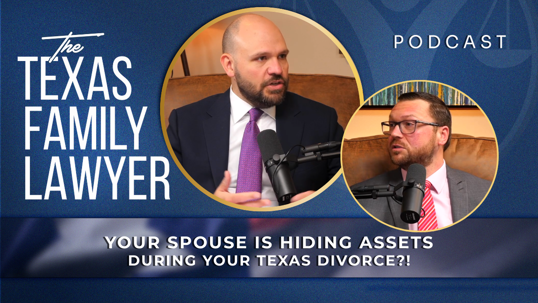
Alex Hunt:
This is the Texas Family Lawyer Podcast. I'm Alex Hunt of Hunt Law Firm, a family law firm with offices in the greater Houston area. Today, I am happy to be joined by David C. Adams, our lead attorney in our League City office.
Welcome, David.
David Adams:
Thank you, Alex. Glad to be here.
Alex Hunt:
Today we are going to be talking about what to do when your spouse is hiding assets in your Texas divorce, and we're really going to dig in. We're going to talk about how to find those hidden assets, what to do when your spouse is not cooperating with discovery requests, which is typically the way that we try to find those hidden assets, and what to do when your spouse has wasted money. You finally locate the assets and you realize that they are gone. So let's jump in.
All right. Our first question today is going to be how to find assets in your divorce case. In Texas divorces, uncovering hidden assets is critical for achieving a fair property division. Texas is a community property state. It's covered by the Family Code Chapter 3. All property that's acquired during the marriage is assumed to be community property, unless you can prove by clear and convincing evidence that it is separate property.
So oftentimes, in the cases that we have, we might have one spouse that is trying to hide some of those assets. Tell me a little bit about, David, some of those red flags or tactics that you see opposing parties using to try to hide their assets.
David Adams:
The most common thing that we see is failure to respond to discovery. People generally aren't going to want to turn over their financial documents and answer certain questions about their finances if they know that it might turn over something that's going to hurt them or something suspicious. So that's usually the first red flag. The second red flag I would say is your client. Your client probably has a suspicion. Oftentimes, their spouse might be doing something that they're not supposed to do. They may not be sure exactly what. And so that's why your client interview and communications with your client can be important to at least give you a direction to go in to know what you might be looking for.
Alex Hunt:
One of the things we often see is a lot of secretive behavior. I mean, you're in a divorce case. And so obviously there's going to be... It's an adversarial process, but you'll see the other party behaving secretly, not just not responding to discovery requests, but they're hiding what were previously community passwords for bank accounts, things like that. And now they're changing those passwords. They're withholding things from their spouse. Our client or the other spouse, they can't access bank accounts. They can't see anything anymore.
Another one is just unexplained withdrawals or debts. One of the things that I often see is an opposing party will take out $100 here from the ATM. We're living in an increasingly cashless world. So it's unusual when somebody is taking out $200, $300 every few days. The question is, where is that money going? It's unable to be tracked. Well, those are questions that you would need to get answered through a discovery request.
David Adams:
Absolutely.
Alex Hunt:
Tell me a little bit, David, about some of the formal discovery tools that we use as family law attorneys to try to identify some of these hidden assets.
David Adams:
The most common tools for discovery is written discovery. And the three common forms are written interrogatories, requests for production, and request for disclosure. Now, written interrogatories are literally just questions on paper. They're asked to the opposing party that they have to respond to and then swear to the answers.
Let's say that you had maybe gotten some financial documents from your client as part of the divorce and it shows, to the point that you just made earlier, it shows ATM withdrawals. You could write an interrogatory and say, "See the attached financial statement. This transaction on this day, that transaction on that day," explain or tell us where that money ended up. You could be that specific. You can also be more general in your written interrogatories. Tell us all bank accounts that you have and what institution they're located at, different things like that.
The request for production is going to be really where you're going to get the meat. You're going to get the documents. You're going to get the financial documents that are going to form the basis of your case. One thing I have to tell clients that sometimes can be frustrating if they've been married for a long time, unfortunately, most financial institutions only keep financial records back about seven years. There are a few exceptions. Sometimes they'll surprise you, but generally speaking, that's as far back as they'll go. So even if you go to your bank or the opposing party goes to their bank, or even if you were to, say, use a subpoena, which I'm sure we'll talk about in a minute, to try to get records, the most you can usually hope for is about seven years worth of records. Request for production is where you'll get that. You can get financial statements. You can get credit card statements, tax returns, pay stubs.
Sometimes tax returns and pay stubs can be very helpful. I've worked a lot of cases where a spouse is having their check direct deposited to a joint account. The other spouse doesn't know that for years they've also had a second hidden account and they've had a portion of their paycheck, which you can now see on their pay stub that's an indirect deposited to that account. So that can be very helpful.
Alex Hunt:
Those are the easier ways in order to try to get information in a divorce. You're literally asking the other party, "Give me information. Give me bank statements. Answer these questions for me." But if you have an opposing party that's going to play hardball, they're not going to follow the rules, there are some less common tools that we typically use. The first one is doing a deposition. That's where you're literally sitting at a table with a court reporter, sometimes a videographer, and the lawyer is asking questions under oath to that party. That party has an obligation under the law to answer those questions truthfully. But if you'd believe it out there, viewers, sometimes people don't answer those questions truthfully or they still try to hide facts. And so there are additional things that we can do outside of asking the other party for help in identifying those assets.
And so those look like, David, you mentioned subpoenas. Tell us a little bit about how that can be helpful in identifying hidden assets.
David Adams:
There are two different kinds of subpoenas that you can issue. There's one called a subpoena duces tecum, which is where you issue a subpoena to a person or to an entity like a banking institution and say, "We want you to show up at this hearing or at this trial and testify and potentially bring documents with you when you come to that." I generally counsel clients that that's our last resort because it's generally not advised to have a hearing or a trial where a witness is going to show up, A, to say things you're not sure what they're going to say, and B, to bring documents you've never seen before. But sometimes that is the way you have to go.
There's another type of subpoena that you can issue to third parties to have them show up and essentially do the same thing, but to have them show up at a neutral location like your law office and produce documents at that location. And so, usually, the way the process typically works in litigation, you issue your written discovery request to the opposing party, you give them an opportunity to see what they're going to respond with and what they're going to say. You usually will draft and send what's called a deficiency letter and say, "Here's how the responses you've given us are deficient." And then oftentimes you'll have a motion to compel discovery hearing. After that step in the process is usually when I turn to a client and I say, "Look, I think the opposing party is going to continue to try to play games with us. It might be money better spent for us to issue a subpoena directly to the bank or to the employer or to the whatever company we might be seeking records from and see if we can get the information directly from them."
Alex Hunt:
Occasionally, you'll have somebody who is not following the rules. You're not even able to identify where they bank and where they hold money. And in that instance, one option is to utilize a private investigator. Usually when people think of private investigators, you think of somebody that's tailing your spouse and seeing if they're having an affair or they're going here or they're going there, but private investigators, specifically ones with a background in forensics and financial forensics, can run a search and they can identify, at least within the state of Texas, or you could do it on a state-by-state basis, where that person has bank accounts. They're not going to be able to tell you how much money's in those bank accounts, but they'll be able to say they have a bank account at Chase or at Wells Fargo, and that allows us as the attorneys to then go and issue a subpoena to Chase or Wells Fargo and go and get those records.
So all hope is not lost if the other side is truly not giving any type of information whatsoever.
David Adams:
That's right.
Alex Hunt:
David, let's say we finally get the records. They are filled with information that we can't really make heads or tails of it. The client doesn't know what these transactions are. We're trying to trace money that's coming in and out of the accounts. One option that we have then is to hire a forensic accountant that can help us figure out what's going on with these accounts. Tell us a little bit about what a forensic accountant can do.
David Adams:
What a forensic accountant can do is that they can go in and analyze what's often thousands of pages of financial documents. They have different... I've worked with a few and one of them has showed me before some of the software that they use. They have some different programs that they have available to them that most of us don't have that allow them to be able to much more quickly piece together what money is going out and then into different places so that you can see a flow of cash or a flow of assets. And that can be very helpful, not only in being able to tell you as the litigator maybe what's going on, but you can also potentially call them as a witness at your hearing or at your trial to fortify your case that maybe the other spouse has been wasteful or fraudulent.
Alex Hunt:
And in addition to analyzing bank records and using some advanced tracing methods, they can also look at things like bank records, business records for under-reported income or sometimes fake expenses. We see that sometimes. It's money that is fraudulently going to people that it looks like a business expense on a business financial statement, but it really isn't, and they can help us identify that.
Give us some advice that you would have for somebody that's out there looking that might be faced with a situation where they've got a spouse and a divorce that is not forthcoming with information. What advice would you have for them?
David Adams:
I would say if you're pre-filing for divorce, I would say that you want to do your homework and try to get your hands on as many documents as you can and save those documents in someplace that's safe and secure that you know the other party doesn't have access to. Oftentimes there's a gap in time between, say, filing for divorce and being able to get out discovery requests. Or even in some cases, if you serve discovery requests with a divorce filing, there's still a period of time, usually 30, sometimes up to 50 days that these parties have to respond to these requests. And there's a lot that they can do and hide and delete in that kind of timeframe.
So I would say if you're a spouse that's worried about that kind of behavior, you definitely want to try to take what steps you can to secure the documents and the evidence that you can. It doesn't have to be perfect. I mean, sometimes anything can help or can point us as the litigator or the financial expert in the right direction.
Alex Hunt:
Yeah. And like you said, start gathering those documents early. I don't think that it's particularly helpful for our clients to confront their spouse about certain types of spending, but keep logs of it. Get the financial records when you can, keep it safe. Don't keep it where your spouse has access to it and can withhold it from you or can delete it. And remain proactive in monitoring your accounts and take screenshots when you see activity that is unusual and take note of it because anytime that you can take note of it and draw it to your attorney's attention, that's going to be less time that your attorney needs to go and do the digging because you're doing that work on the front end.
And then the last piece of advice, which it might be obvious is get a legal professional, get an attorney on board as soon as possible because they're going to be able to guide you through this process. It's very complex. There's very complicated laws that are at play here, and a lawyer is attuned to what is necessary in order to prove these claims in court. They're going to be able to help you guide you through that process.
David Adams:
Absolutely.
Alex Hunt:
All right, David, our next question is, what to do when your spouse isn't cooperating in your Texas divorce? Particularly, you've sent discovery requests to try to get information from your spouse and they're not answering those discovery requests. So first, let's just briefly go over what some of those discovery requests that you could send to the other side to try to get information. What are those discovery requests?
David Adams:
The most common ones are request for production, which is where you request a party to produce items. Generally, it's going to be statements, right? Financial documents, tax records, pay stubs. Those are going to be the common things. If custody is an issue in your case, you might be requesting text messages, emails. Those would be the most common things that you would request in a request for production. Written interrogatories are questions on paper that you ask to the other party. You ask them to answer those questions in writing, and then they're supposed to literally swear, have notarized or declare that those answers are true and accurate.
There's another thing called request for disclosure, which normally is answered by the attorney that's representing the party, but one of the features that is important in request for disclosure is that parties have to disclose what are called their factual basis and legal theories that support their case. For instance, if you were coming after your spouse saying that they had wasted community assets, you would need to point that out in your request for disclosure and do so adequately enough ahead of trial so that everybody knew that was a claim that you were making.
There's also, although not as commonly used, requests for admission, which the way to think about that, I explain it to clients is it's like true/false. You write a series of questions that are basically admit or deny this thing. Admit or deny that you have an overseas bank account. Admit or deny that you had a sexual relationship outside of the marriage. And then the other party has to literally admit or deny a true or false each statement.
Sometimes, depending on the question, sometimes that can be helpful. It's an easy and quick way to let you know if you're thinking about a topic or an issue is correct or wrong. And especially if the other side say isn't represented by a lawyer, but sometimes even when they are, if you miss the deadline to properly respond to those requests for admission, they're deemed admitted, which means they're all taken as true. And it can be complicated and difficult sometimes to get those admissions withdrawn if you've missed your deadline.
Alex Hunt:
So you've sent these written discovery requests to the other side. They have an obligation to answer those written discovery requests in writing within 30 days. Occasionally, on cases, we will get written discovery requests that responses are insufficient. So while they answer, they really don't give us the information that we truly need, or they only give us partial information. And then sometimes, we just don't get a response back at all after 30 days.
David Adams:
Correct.
Alex Hunt:
What we typically do is we try to resolve it informally first. We'll reach out to the other side. We'll send them a deficiency letter, which tells them, "If you did answer or you gave partial information, then there's additional information that we need." We give them a deadline. We say, "This is what we need you to do. We need you to remove your objections. We need you to give us additional bank statements. We need you to give us additional information and an answer, and we need you to answer it by next Friday." And if they don't answer it by next Friday, our next step is we go to our client, we say, "We need to file a motion to compel responses," which is a court proceeding in which we go to court and we ask the judge to force them to answer and there's potential penalties that are associated with that.
Tell me a little bit more about the process to bring a motion to compel and what the outcome could be in court.
David Adams:
The most important thing is the step before the compel, which is the deficiency letter. The reason I say that is because the way I conduct my motions to compel, and I think most other lawyers I think do a good job at this is your deficiency letter needs to very specifically lay out what has been produced by the opposing party and what you're missing. I think if you send a letter that just says, "Hey, we have some problems and you're not specific about what they are," or you say, "Here's what I'm missing," but maybe you don't say what they did give you, I've found that when you go to these hearings, there can be a lot of back and forth about, "Oh, I gave that to you." or, "I gave you this and I gave you that." And so if your letter very clearly lays out, "Here's what I have. Here's what I don't have. Here's what I need," that's the best basis for the motion to compel.
When you go to the hearing, one of the biggest things, and I try to tell my clients this, sometimes when the other side is saying that we haven't properly produced something or enough information, I tell them, "Look, anytime you go to a motion to compel hearing, you're going to run the risk that you're going to have to pay the other side's attorney's fees that are associated with the motion to compel." So if you don't want to do that, you want to make sure that you try to comply as fully and completely as you can. And I would say, while not always, I would say more times than not, when you go to those compels, the judges are often awarding some amount, maybe not everything you're asking for, but they're often awarding some amount of attorney's fees to the other side.
Alex Hunt:
And there's got to be some sort of penalty when the other side doesn't follow the rules. We've got the Texas Rules of Civil Procedure. It outlines discovery requests and it says that you have to answer within 30 days. And if you just don't answer or you answer so incompletely and then you get a polite, informal request from the other side, "I need additional information," and you just don't provide it, I mean, it's really contemptable behavior and the judge has to issue some sort of penalty.
And so the first time, you're usually going to get the court to issue an order that's going to say that you have to answer it completely and they're going to issue some attorney's fees to compensate the side that was asking for it, didn't get it, you got to compensate their attorney. But if after the second time or the third time that you don't answer and you have to go back to the court again to get assistance, then you start getting into possible penalties that can really impact your case upon final trial. We call them informally a death penalty sanction, which means that the court could order that you can't bring any witnesses at the final trial. You can't bring any evidence at the final trial. And even if you're not a lawyer, you can imagine not being able to bring witnesses in your divorce trial or not being able to present evidence in your divorce trial, this reason it's called a death penalty. It kills your case. You can't present your case and it puts you at an extreme disadvantage. So that is the biggest penalty that a court can impose in a motion to compel. I would avoid it at all costs. We certainly caution our clients, before you decide not to provide proper responses, think about the potential consequences.
David Adams:
That's absolutely right.
Alex Hunt:
Let's talk a little bit about best practices and just some words of caution for anybody that might be out there and words of caution that we give to our clients. The first thing that I would recommend that folks do is to always document your attempts to get your needed discovery. That's going to help set you up for success if you have to do a motion to compel or if you have to go and try to go and seek some penalties against the other side. We save all of the email threads that we have with the other side, any deficiency letters or correspondence that we send to the other side trying to informally resolve the case without having to go to court. But judges have pretty broad power to impose penalties, especially once they've ordered responses to be given to the other side. They typically have little tolerance for people playing games and withholding information.
So the advice that I always have for my clients, I'm sure you do for yours, is be very careful if you're the one that's withholding documents about what the potential consequences are. And if we're on the other side where we're requesting documents, we're going to cross every T and we're going to dot every I, and we're going to get those documents eventually, or we're going to make it so difficult for you to prove your case in final trial that it's going to bite you in the behind in the end.
What other advice do you give to clients or would you have for viewers that are facing a spouse that is refusing to provide information?
David Adams:
Well, one piece of advice I would have for our clients, I always try to tell our clients now is, when we send you the discovery request that the other side has given us, start working on it, start working on it now. What I find in most of the cases is that the clients don't produce something, at least our clients, not because they're trying to hide it, but because it's just tedious and cumbersome and a pain in the butt to do it. There is no doubt about that. That is the truth. In a lot of ways, discovery is like a big homework assignment, but the truth is that it's not only very important to the case, but as we've talked about, there are serious penalties that can be very harmful to your case and costly financially if you don't do that. So I try to encourage the clients as much as you may not like it, as much as you may not understand why your tax return from seven years ago is really relevant to your divorce case now, if they're asking for it and a judge is likely to think it's relevant, we need to turn it over.
The other piece of advice that I would give, if you're concerned that the other side might be hiding assets or not being compliant with discovery is, A, give me as much help as you can, as in, if there are documents that you can get, whether that's at your house, if they're in a financial account somewhere that you can access, do that because it's definitely going to be faster and cheaper for everybody if I can get them from you in some fashion rather than having to compel or force the other side to do it.
You did mention something earlier that I do think is important. No one in a divorce case should try to confront their spouse about fraud or about waste or about, "I know you're hiding X, Y, and Z." Those conversations, in my mind, usually aren't very productive, A, and sometimes can be dangerous. And you definitely don't want to take documents by breaking into something, whatever that's something might be, a filing cabinet or an email account, that you're not supposed to have access to. Having said that, everything is community property. Well, everything that's not separate property is presumed to be community property. And if you're married and you do have access to it, if the filing cabinet's not locked and it's in your home, arguably you've got free-range to whatever's inside that cabinet. And if there's documents in there that might help us, it might be a good idea for us to utilize that. So help me as much as you can.
The other thing that I would say is, look, it's not cheap when we have to go through thousands and thousands of pages of documents. Sometimes a client will come to me and they'll say, "Here's 5,000 pages worth of bank statements. I don't trust my spouse. Figure out if he's been doing something suspicious," which we can do. It's a lot more beneficial, I think, for the client and cheaper for them. If they come to me and they say, "Here's 5,000 pages worth of documents. I've gone through here and highlighted all of the charges that I think are suspicious. This will give you a starting place. Please take this and run with it." That's a lot cheaper for the client and it helps me zero in on what's really important.
Alex Hunt:
Okay. Our next topic is what to do when your spouse has wasted money in a Texas divorce. Particularly, we're talking about community waste, and that has a very specific definition in the Texas Family Code, and it refers to a spouse's reckless or intentional depletion of community property, and that's usually through excess spending or gifting or gambling or just outright fraud. It could be constructive fraud or actual fraud. That section, for those who might be dealing with this and are looking at for specific code sections, would be chapter three of the Texas Family Code, and all assets acquired during the marriage belong to the community.
One of the things folks don't realize is that even if you receive income as a result of your employment or you are the one that is managing funds that you've gotten through your employment, you have a fiduciary duty to your spouse to handle that money responsibly and reasonably. And if you fail to do that, then your partner, your spouse in a divorce could have a claim to community waste.
Give us some examples that you've seen in your practice of wasteful spending that could classify as community waste in a Texas divorce.
David Adams:
Well, remember, waste... I think it's important for clients to keep in mind that waste is relative. By that, I mean, if the income of the community estate on a yearly basis is, say, $500,000, the court or jury is probably not going to think that driving around in a $150,000 car is as wasteful as they might think if the community estate net income on a yearly basis is significantly lower. And that's a lot of times what I run into is two situations, is one where people have pulled money out of the estate or pulled money out of accounts and people aren't sure where it went or what they did with it. That's honestly an easier legal case to make because the way the family code is written and the case law sets that up, essentially if you can prove that money has gone out, then the burden shifts to the other side for them to say what happened to it and what they did with it and to justify it. And presumably, if you can show that it went out and their justification doesn't make sense or isn't believable, then that should establish and prove a waste claim on your client's behalf.
But the other issue that I run into and frequently see is where people essentially are living beyond their means. They're spending every dime. And in some of those cases, if both parties have basically been agreeing to live that way, it's a lot harder to make a waste case. But if one of the spouses has essentially been in control of the finances and they've been the one that's been doing the majority of the spending and the other spouse hasn't been in agreement with that, then you you can have the basis for a waste claim in those cases.
Alex Hunt:
Yeah. An incredibly important part of a waste claim is that the other side didn't have knowledge and didn't consent to the behavior. I personally had a case where somebody was spending an inordinate amount of money on a vehicle that he had. He went and got a very expensive vehicle. He already had a vehicle. He went and got another vehicle. He was fixing up the vehicle. His spouse didn't know about that, didn't consent to it. That's wasteful spending. If you're just talking about going on vacations together, that's their lifestyle. They've consented to it. They went on the vacation. That's not what's going to qualify. T.
Hen you have some aspects that are just outright fraud. When you take money and you say, "I've got a divorce coming up. I have $20,000 in a bank account. Let me transfer this to my brother or my sister or my father or my friend." That's just outright fraud because you're trying to withhold that money from the other spouse or taking it out of the community estate.
So what happens... You talked a little bit about proving the claim. We make the claim that there is a community waste. We show that there was no knowledge, that there was no consent. The burden shifts to the other side. Let's say that the judge says, "I agree. There was no knowledge. There was no consent, and this is lavish extravagant spending." What would happen next is that you have what's called a reconstitution of the community estate. Tell us a little bit about what that means.
David Adams:
Remember, when you sit down to do a divorce, you basically start with a spreadsheet and you try to build up on your spreadsheet the community estate. And then if there are any separate property assets, you're going to put those on there as well. Essentially, what you do with a waste claim is, if you go to trial and a judge says, "Yes, I believe this is a legitimate waste claim and now we're going to reconstitute the estate," what they should do is they should take the value of the wasted asset or item.
So let's just say for easy math that the waste claim was $1,000. That they believe that one of the spouses pulled $1,000 out of the estate, maybe they have no explanation for it or not a believable one. We're going to reconstitute the estate by $1,000. So on the spreadsheet that the judge at that point would be using, they would then essentially add in $1,000 that was missing from the community back into the community estate. And then, once they've added in all the waste claims and reconstituted that estate, then they would go to divide the estate.
Alex Hunt:
So just to add a little bit more color to your example, say your total estate is worth $5,000, and let's say that the judge is going to divide it 50/50, which they don't always have to. They just have to divide it in a just and right equitable way. But let's say the total estate is worth $5,000, but they find that there was $1,000 worth of waste. So they add that back to the community estate. So now it's worth $6,000 and they're going to divide it 50/50. You get 3,000, you get 3,000, but the party that wasted the thousand, it's like they're only getting $2,000 of what's left. The other side is getting their full 3,000 because it's like, you already got your $1,000. You wasted it. You spent it. We're putting it here as this phantom number in the spreadsheet and you're getting it, but you really already spent it and your spouse shouldn't have to be penalized for that.
David Adams:
That's exactly right. One of the most heartbreaking things, honestly, that I deal with with my clients is if a client comes to me and it looks like they have legitimate waste claims that have occurred by the other spouse, but essentially the community estate has nothing in it. Because at that point there's not a whole lot of good options for you as the lawyer or for the judge, where do you pull money from if there's nothing to pull from? So you hope in those cases that there are some assets, whether it's maybe a marital home with equity in it, maybe it's a retirement account, a 401(k) that's got some dollars in it where you can try to make your client whole to offset the waste claim that the other spouse has committed.
Alex Hunt:
And unfortunately, if we do have a situation where the estate is not big enough to make up for a large waste claim, one of the things courts can do is issue an equalization payment, which is where the offended spouse would get a payment made to them by the offending spouse potentially over time. But when you do that, a lot of times, unless there's some sort of underlying property that they can secure it against, it's really just a piece of paper that says that the other person needs to pay you. And Texas has such stringent rules on paying judgments that oftentimes, a lot of times, that doesn't happen.
So advice that I would have for clients is start documenting this waste as soon as possible. I would also let your spouse know that you don't agree with their spending if you-
David Adams:
In writing.
Alex Hunt:
In writing. In writing, while it's actually happening. They go out, they buy the $70,000 vehicle on top of the vehicle that they already have to get them from point A to point B. Tell them in writing, "I do not agree. I do not consent to this," so that way you have some evidence that this was something that you didn't agree to. And keep records of all that, keep screenshots of that. Go through your bank statements for your lawyer and document what you see as wasteful spending. Potentially it's spending money on a paramour or an affair or it's money for the hotel or it's just spending extravagant amounts of money at a bar every night. All of those things count or could count as community waste, and those good records are going to help your attorneys immeasurably.
David Adams:
Yeah. And I would just say on that note, if you're somebody who's not sure if you need to get a divorce, but you're in a marriage where you think your partner is spending lavishly or might be engaged in wasteful spending, I would just encourage you to try to have a conversation with them about what's going on and get the answers that make sense to you. If they're not willing to do that, then divorce might need to be an option, because often what happens with me is that clients will come to me and they will tell me that for years they have been suspicious or for years they have known something was going on, but they just weren't sure what, and they didn't press the issue and they let it lie. And then once we peel the onion back, we find out that the situation is much worse than they ever imagined and now their options are really limited.
Alex Hunt:
So if your spouse is hiding assets or you know that your spouse is wasting assets, the biggest piece of advice and what I would want folks to take away from this is to be proactive, is to find a lawyer that can help guide you through this legal process, take note of the records, go and get the records. Lawyers will use, our firm certainly knows how to use the legal tools available to us to go and get that information. We are going to get that information, whether they try to keep it from us or not, and in the end, it's going to bite them in the behind, but go and find a legal representative that can advocate for you and can get on top of this problem before it blows out of proportion or you've got the situation that's been going on for years and years and years and gets beyond our control.
Well, David, thank you so much for joining me today and we'll see you next time.