
As people begin the journey of separating from their spouse, they sometimes find themselves dating again prior to finalizing the divorce. In Texas, parties must wait at least 60 days before finalizing their divorce, which is a relatively short period of time compared to many other states.
However, in most cases, getting a divorce actually takes months or even over a year before the divorce is final. In some cases, the divorce process can even take years if the estate is large or there is a big custody battle between parents. During this time, it is not uncommon for people to start dating again even though they are still married to their spouse. However, as we will discuss below, it is not recommended to start dating again until after the divorce is finalized.
After entering a new relationship, a person going through a divorce may feel inclined to progress in their new relationship, prompting them to ask their attorney whether they can have a new partner move in while the divorce is pending. This blog will explore whether it is advisable to have a new partner move in with you if you are going through a divorce.
An Attorney’s Take: Do Not Move In
The short answer is no, do not move in with your romantic partner while you are going through a divorce. Furthermore, it is not recommended to date anyone during the divorce process in general.
People oftentimes do not like to hear this advice because they do not feel that they should be restrained from moving on during a separation. Many people are ready to move on and do not understand why they need to wait to be legally divorced if they are living a completely separate life from their spouse. This belief is especially true for individuals who have been separated from their spouse for years.
Most people do not listen to their attorney’s advice and decide to date someone new and move in with their new partner anyway. However, it is important you understand the possible legal implications in your divorce if you decide to move in with someone you are dating while you are still married.
Unlike some other states, Texas does not have a legal separation. In Texas you are either married or divorced – there is no middle ground. If a person starts dating during the divorce, they are technically committing adultery under Texas Family Law.
While committing adultery is not advisable, Texas courts oftentimes place more importance on whether or not a spouse is spending money on new partners. Since Texas is a community property state, everything you acquire during marriage is presumed to be community property. If a spouse is spending money on a new partner, their wife or husband can file something called a waste claim.
Waste Claim (or Fraud on the Community)
As mentioned, Texas does not have a legal separation. In Texas, parties are married to each other until they are divorced. Why does this matter? It matters because Texas is a community property state. This means that any property you accumulate during a separation is still considered community property. For example, the income you receive from your job would be considered community property and subject to division by a family law court even if you are living separately from your spouse. If you went and bought a house while separated, your spouse would have a legal interest in that house even if the house is not in their name.
People separate from their spouses all the time and try to financially separate themselves from one another. What people do not realize is that it is really difficult to not continue to acquire community property during a separation unless the parties have a pre-marital agreement or a post-marital agreement with specific language on this issue.
Parties begin to experience serious issues when they start using community property to benefit a third party, such as a new romantic partner. There are many ways a spouse can end up using community property funds to benefit their new romantic partner like if they move in together. Using one’s income to pay for rent, utilities, food, and other things that go into living with someone are some examples of a spouse using community property funds to benefit a third party. An attorney would advise against moving in with a partner and spending money in this manner because that person’s spouse can plead for a waste claim.
The most common waste claim occurs when a spouse uses community property funds to benefit a romantic partner. Community property funds should be spent only on the spouse, the parties’ children, and reasonable expenses during the divorce, not on a romantic partner.
Discovery: Gathering Evidence for a Waste Claim
A party can plead for a waste claim and request that the court order their spouse to reconstitute the marital estate for the money “wasted” on the new romantic partner. You might be thinking, how will my spouse find out about money I spend on my new partner? The answer: during discovery.
Discovery is a process during a divorce where the parties request and send documents between themselves or between their attorneys and answer certain questions. Discovery in the vast majority of divorces involves sending bank statements to the other party. Attorneys, and sometimes parties themselves, go through the bank statements in search of any irregular spending or suspicious transactions.
One of the main reasons attorneys will examine bank statements is to identify whether the opposing party has been spending money in a way they should not during the divorce, such as on a new partner. For example, two people are separated for the past year while going through their divorce. During the divorce, one of the spouses begins a new relationship and decides to move in with their new significant other. While living together, the spouse and the new partner begin sending money back and forth to each other, claiming that it is to pay for the electricity, water, rent, and groceries. The attorney uncovers these transactions while looking through the bank statements received as a part of discovery responses. The attorney has an issue with money moving between accounts because the money, which also belongs to their client, is being taken and transferred to a new romantic partner.
If a party prevails on their waste claim, their spouse could be ordered to “pay back” the community estate the amount of money they are found to have “wasted” on their new romantic partner. This often results in the innocent spouse receiving a disproportionate share of the community estate as a way for the at fault spouse to “pay back” the innocent spouse.
In Texas, courts divide a marital estate in a just and right manner. While courts oftentimes divide a marital estate 50 percent to one spouse and 50 percent to the other spouse, courts have the discretion to divide the estate in a way the judge believes is just and right. This means that sometimes the court may give 49 percent to one spouse and 51 percent to the other spouse. However, if the court finds that a party committed adultery, they can award more of the marital estate to the other party.
In cases where a spouse is ordered to reconstitute the community estate, they will ultimately leave the marriage with less assets due to the waste claim. For example, let’s say that a court decides that a just and right division of the marital estate would be for Spouse A to be awarded 50 percent of the assets and Spouse B be awarded 50 percent of the assets. However, Spouse A argued that Spouse B wasted community property assets, specifically their income, by spending money on a new partner during the separation. The Court agrees with Spouse A’s waste claim argument and orders Spouse B to reconstitute the community estate $20,000. If the estate is worth $100,000, this means that Spouse A will leave the marriage with $60,000 and Spouse B will receive $40,000 due to Spouse B’s waste.
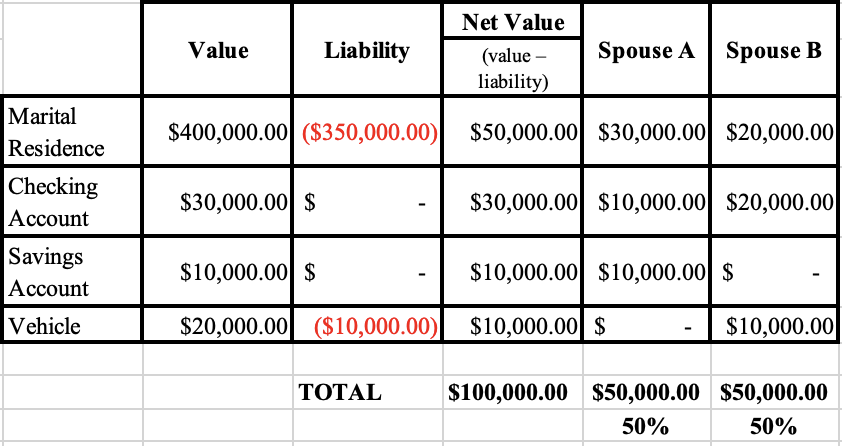
The following table is an example of a property division without a waste claim where the parties are dividing the estate equally between themselves.
The following table is an example of a property division in a case with a waste claim as explained in the example above.
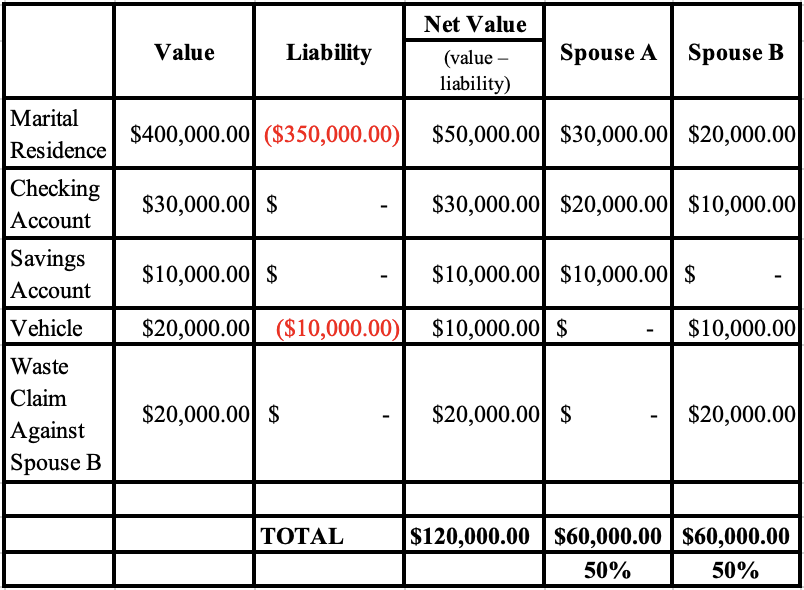
In this example, Spouse A had a waste claim against Spouse B. Because Spouse B wasted $20,000.00 of funds, that gets added to his/her column. In reality, Spouse A walked away with $60,000.00 in assets while Spouse B only walked away with $40,000.00 in assets. The estate appears to have $120,000.00 due to the $20,000.00 waste claim.
Impact on Children
In addition to possible issues regarding property, moving in with a new partner can negatively impact one’s children. Children are resilient, but that does not mean they should not be afforded the opportunity to accept their parents’ divorce in a healthy way. Rushing into living with a new partner can put a lot of pressure on children to accept their parents’ separation even before their parents are legally divorced.
Parents should make sure they are taking the time to check in with their children to see how they are coping with the divorce. Some children take longer than others to fully accept their parents’ divorce. Even for children who are not struggling, introducing them to a new partner and expecting the children to live with a stranger can be a lot to ask of a child going through such a big life transition.
Courts want to see parents involved in their children’s lives. Dating while getting a divorce can distract parents from focusing on their children and occupy important time that a parent needs to devote to spending time with their children. Courts would not look fondly on a parent who opts to dedicate time to their new partner instead of their children – especially if conservatorship is at issue. Additionally, while new partners can be great stepparents in the future, it is important for parents to show the court that they, not their new partners, are taking care of their children.
As hard as it might be, it is not advisable to move in with a new partner during a divorce. A divorce is a time period of great change, not just for the two people going through the divorce, but for an entire family. Make sure you are taking the time necessary to focus on navigating this transition in the healthiest way possible. Remember, a divorce is not the best time to move in with your new romantic partner because such a move could negatively impact both your property and your children.