
On September 1, 2025, Texas implemented major changes to its child support guidelines. These updates, under House Bill C.S.H.B. 2643, are among the most significant in recent years, especially for families where one parent has a higher net income. It's important for parents to understand how these changes may impact current and future support obligations, and what options you might have.
What Changed
Increased Income Cap for Guideline Support
Before September 1, 2025, when calculating child support under Texas’s guideline, the court would only consider up to $9,200/month of a parent’s monthly net resources (net income). Even if a parent earned $15,000 net per month, the court would only apply the child support guidelines to the first $9,200 a parent made. In short, any net income above $9,200 was not factored into the calculations for child support.
As of September 1, 2025, that cap has increased to $11,700/month. That means more income is “on the table” for support calculations in higher‐earning households.
Higher Guideline Support Amounts for Multiple Children
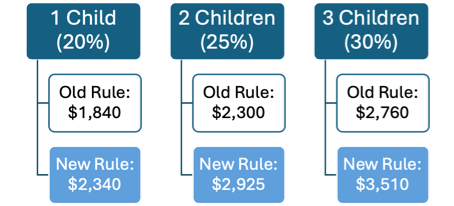
Because of the raised income cap, the guideline amounts (which are percentage-based) go up when parents have earnings above the old cap. Some examples under the new guideline:
Same Percentage Guidelines Remain
The percentages that apply to children (20% for one child, 25% for two, 30% for three, etc.) remain the same under the law. What changed is how much income is subject to those percentages due to the higher cap.
Which Cases the Changes Apply To
Any child support order finalized on or after September 1, 2025, will be calculated under the new cap and guideline, including both new cases and modifications filed going forward. However, if you previously entered into a Mediated Settlement Agreement with the old child support guidelines before September 1, 2025, the old guidelines will apply even though your case has not yet been finalized by the Court.
Existing orders (those finalized prior to September 1, 2025) are based on the old cap unless one party seeks a modification and meets the required legal standard.
Who Is Impacted
These changes will not affect everyone equally. These are the main groups likely to see an impact:
- Higher‐earning parents: If you earn enough that your net monthly resources are above the old cap ($9,200/month), more of your income will now be counted toward support. That could mean substantially higher payments for paying parents.
- Receiving parents: If you are the parent receiving support and the paying parent’s net income was limited by the old cap, you may see an increase in what you could receive if you seek a modification.
- Parents with existing orders: If your order was entered before September 1, 2025, you may be able to get a modification if circumstances qualify (e.g. a material and substantial change) and if the paying parent’s income is high enough that the old cap was relevant.
- New cases: Any new child support determination after September 1, 2025, will follow the new cap and guideline amounts.
What You Can / Should Do
It is important to follow these steps if you believe the new change in law will affect you:
- Review Your Current Order – If you have an existing support order, find out whether it was calculated using the old income cap. If yes, and if circumstances have changed (especially income changes), it may be possible for you or the other parent to request a modification.
- Gather Financial Documentation – To pursue a modification or to anticipate what a new order might look like, be ready with clear, up-to-date proof of income by gathering tax returns and paystubs.
- Request a Modification – If you have experienced a material and substantial change in circumstances, you may be able to seek a modification in your existing order. To modify child support, you can discuss with a private attorney or the Office of the Attorney General.
- Evaluate Budget and Ability to Pay – For an Obligor (a parent paying child support), higher guideline obligations may mean adjusting your budget or negotiating with the other parent where appropriate. Even when guideline rules set a standard, there can be considerations (e.g. extraordinary medical costs, special needs, etc.) that modify what’s reasonable.
- Monitor and Plan Ahead – The legislature and Attorney General reviews these guidelines every few years. Economic conditions, inflation, cost of living — all may lead to future updates, so maintaining good records and staying informed is wise.